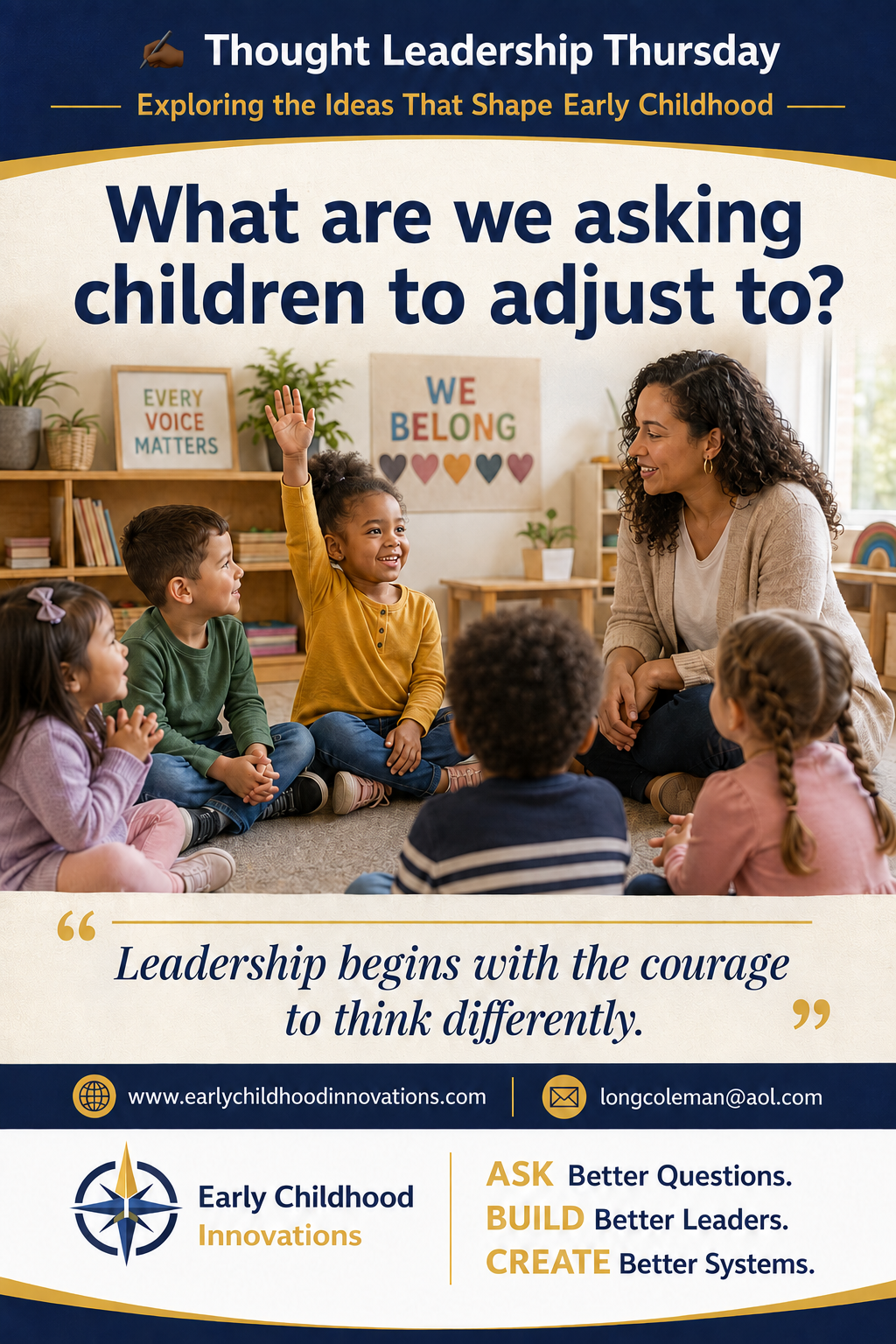
What Are We Asking Children to Adjust To?
Reverend Dr. Martin Luther King Jr. once challenged the assumption that being “well-adjusted” is always a sign of health or success. He acknowledged that adjustment has value, but he also insisted that some conditions should never be accepted as normal. He declared that he would remain “maladjusted” to racial segregation, religious bigotry, economic inequality, and poverty, and called upon people of goodwill to do the same until a more just society was realized.
His words raise an important question for early childhood educators: When we ask a child to adjust, what exactly are we asking that child to adjust to?
In early childhood settings, adjustment is often treated as an important developmental goal. We want children to follow routines, manage their emotions, cooperate with others, communicate their needs, and participate successfully in the classroom community. These are valuable skills that contribute to learning and healthy relationships.
However, Dr. King’s message reminds us that adjustment should not be confused with silent acceptance. A child should learn how to function within a community, but that child should not have to surrender identity, dignity, culture, or voice to belong in it.
Looking Beyond the Behavior
Adults often use behavior as the starting point for evaluating a child. A child may be described as disruptive, defiant, withdrawn, aggressive, inattentive, or difficult to manage. The educator’s immediate goal may become stopping the behavior and helping the child conform to classroom expectations. But behavior is communication.
What appears to be noncompliance may be a response to frustration, fear, cultural misunderstanding, instability, hunger, trauma, an unmet developmental need, or a classroom environment that does not support the child. A child who refuses to participate may not simply be unwilling. The child may not feel emotionally safe, represented, understood, or capable of meeting the expectation as it is currently presented.
This does not mean that every challenging behavior is evidence of injustice or that educators should abandon appropriate boundaries. Children need predictable expectations, protection from harmful behavior, and guidance in learning self-regulation. Yet effective guidance requires more than asking, “How do I stop this behavior?” It also requires asking, “What is this behavior telling me, and what might need to change around this child?” That shift moves the educator from controlling behavior to understanding development.
When the Environment Must Adjust
Early childhood educators frequently ask children to adjust to the classroom, but we must also be willing to adjust the classroom to the children.
Is the environment culturally responsive? Do the books, materials, images, music, and experiences reflect the children and families being served? Are some communication styles accepted while others are interpreted as disrespectful? Are expectations based on children’s developmental abilities, or are they primarily designed for adult convenience? Are children from different racial or cultural groups disciplined differently for similar behavior?
These questions are not accusations. They are tools for reflection. Sometimes the child needs additional support. At other times, the routine, teaching strategy, adult response, or institutional practice needs to change. Equity requires educators to recognize the difference.
Dr. King’s words encourage educators to remain “maladjusted” to systems that produce unequal experiences for children. We should never become comfortable with persistent racial disparities in discipline, unequal access to high-quality learning environments, low expectations for particular groups, or policies that punish children for circumstances they did not create.
Protecting Children’s Identities
Young children are developing more than academic skills. They are forming beliefs about who they are, where they belong, what they can become, and how the world views them. When children repeatedly receive messages that their language, hair, family structure, culture, disability, behavior, or way of expressing themselves is a problem, those messages may become part of their developing identity. Compliance achieved at the expense of a child’s sense of self is not a successful outcome.
Children need educators who communicate, through words and actions, “You belong here. Your experiences matter. I will help you grow without asking you to become someone else.” This is particularly important for children whose families experience racism, poverty, housing insecurity, food insecurity, disability discrimination, or limited access to essential services. Educators may not be able to remove every hardship, but they can ensure that the classroom does not reproduce the same inequities.
Teaching Children to Recognize Fairness
Young children notice differences and recognize unfairness earlier than adults sometimes assume. Early childhood education should help them develop the language and confidence to respond constructively.
Children can learn to include someone who is being excluded, question why certain people are treated differently, recognize stereotypes, listen to perspectives beyond their own, and seek help when something feels wrong. These lessons are not separate from social-emotional development. They are part of learning empathy, responsible decision-making, relationship skills, and community membership.
Our goal should not be to raise children who are comfortable with every condition they encounter. We should help raise children who can distinguish between a reasonable expectation and an unjust one, and who have the skills to respond without harming themselves or others.
The Connection to Children’s Outcomes
Children learn best when they feel safe, valued, capable, and connected. When educators understand the experiences beneath children’s behavior, they can respond more accurately and reduce unnecessary exclusion, suspension, and labeling. Responsive environments may strengthen children’s emotional regulation, classroom engagement, relationships, confidence, and willingness to take intellectual risks. The long-term outcome is not simply better behavior. It is a stronger sense of identity and agency.
A child who is taught only to comply may learn to remain quiet in the presence of unfairness. A child who is guided to think, communicate, empathize, and advocate may become an adult who helps improve families, organizations, and communities.
The Educator’s Responsibility
Dr. King’s challenge invites early childhood educators to examine both the child and the system surrounding the child. It asks us to teach cooperation without teaching submission, promote self-regulation without suppressing identity, and maintain expectations without ignoring inequity.
The central question is not whether children should learn to adjust. They must develop the flexibility and social skills necessary to live and learn with others. The deeper question is “Are the conditions surrounding them worthy of their adjustment?”
Early childhood education is not merely about preparing children to enter the world as it currently exists. It is also about helping them develop the compassion, confidence, judgment, and courage to create a better one.
As educators and leaders, perhaps our responsibility is not to help children become comfortable with injustice. It is to build classrooms in which every child experiences dignity, and develops the capacity to recognize when dignity is being denied.
That may be one of the most important outcomes early childhood education can produce.
References
Buddha7575. (2007, February 4). Martin Luther King (1967)—Proud to be maladjusted! [Video]. YouTube. https://www.youtube.com/watch?v=zXElYpnlxbw
About the Author
Victoria Long-Coleman, Ph.D., MBA is the Founder and Principal of Early Childhood Innovations. An early childhood educator, leadership coach, author, and speaker, she focuses on strengthening educators, developing leaders, and translating research into practical approaches that improve early childhood systems.
Early Childhood Innovations
Remember your ABC’s:
ASK Better Questions. BUILD Better Leaders. CREATE Better Systems.
www.earlychildhoodinnovations.com
