Why Great Organizations Stop Blaming Individuals
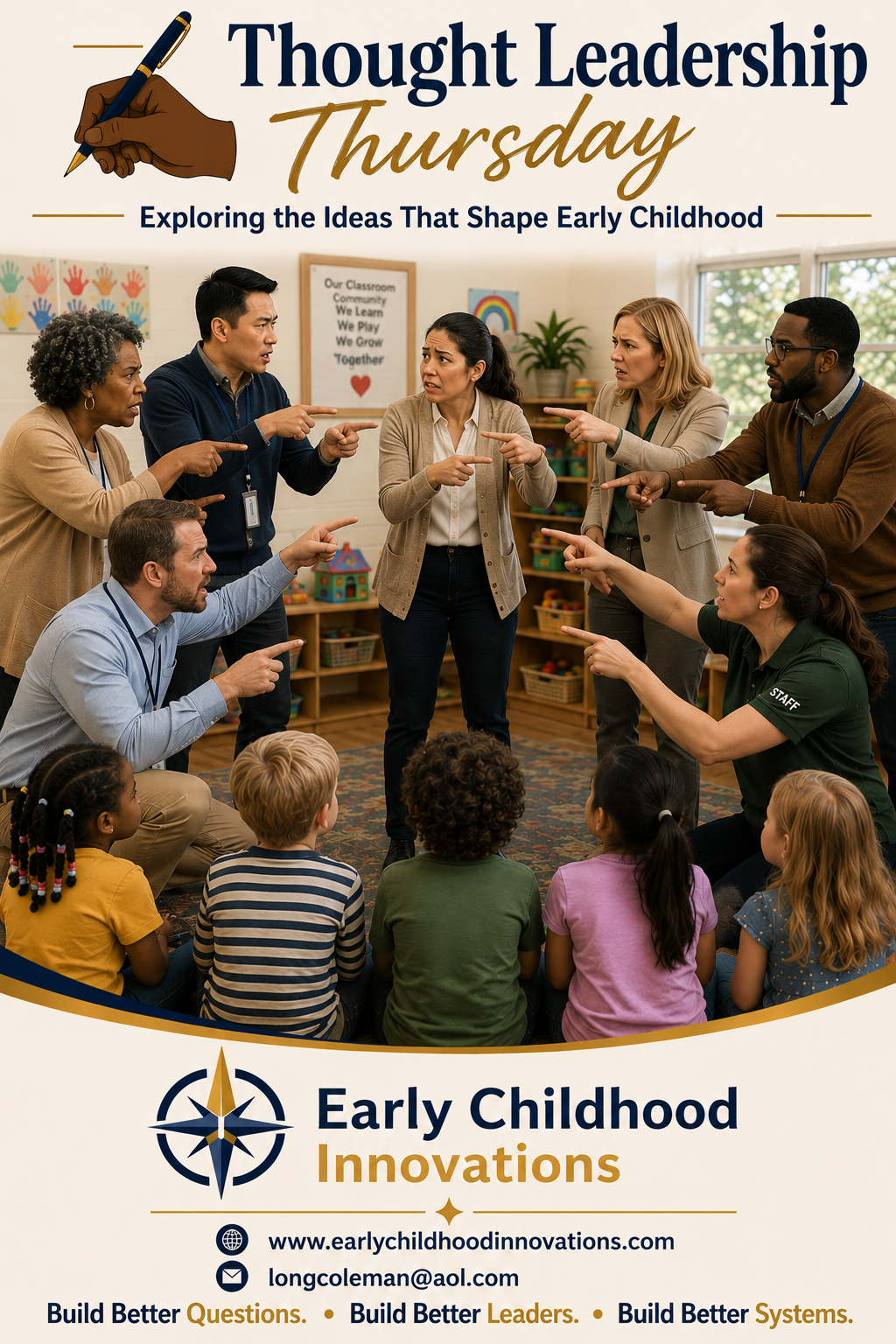
Image walking into an early childhood program after a challenging day.
A teacher forgot to complete a required form.
A child was injured on the playground.
A parent complained about communication.
A classroom schedule fell apart.
The immediate question many leaders ask is:
“Who made the mistake?”
It’s a natural reaction.
But it may be the wrong question.
The most effective organizations ask something different:
“What in our system allowed this to happen?”
That simple shift changes everything.
Looking Beyond the Individual
When something goes wrong, it is easy to focus on the person closest to the problem.
Perhaps a teacher forgot.
Perhaps a director overlooked something.
Perhaps an assistant misunderstood expectations.
Individuals make mistakes.
Yet great organizations recognize that people work within systems. Those systems influence how consistently people succeed.
Instead of asking, “Who is at fault?” effective leaders ask:
Were expectations clear?
Did employees receive adequate training?
Was there a reliable process to follow?
Did the workload make success realistic?
Did our system help people do the right thing—or make it harder?
These questions move leadership away from blame and toward improvement.
The Difference Between Blame and Leadership
Blame often produces fear.
People become reluctant to admit mistakes.
Problems stay hidden.
Innovation slows.
Trust erodes.
Leadership, on the other hand, creates curiosity.
Curious leaders investigate before they judge.
They recognize that every mistake contains information.
Instead of asking, “Who failed?” they ask, “What can we learn?”
That mindset transforms mistakes into opportunities for organizational learning.
What This Looks Like in Early Childhood
Consider two directors responding to the same situation:
A child with a food allergy receives the wrong snack.
The first director immediately asks,
“Who gave the child the wrong food?”
The second director asks,
“Help me understand what happened.”
As the conversation unfolds, she discovers that allergy information is posted in three different places, substitute staff receive inconsistent orientation, and the snack cart was reorganized without updating procedures.
The teacher made the final mistake.
The system created the conditions for it.
Correcting the teacher may solve today’s problem.
Improving the system helps prevent tomorrow’s.
Translating Research into Leadership
Across many fields, including aviation, health care, manufacturing, and organizational psychology, high-performing organizations recognize that human error is inevitable. Their advantage lies in designing systems that reduce the likelihood of error and make problems easier to detect before harm occurs.
Early childhood education is no different.
Children deserve environments where quality depends on strong systems, not on people trying to remember everything or never making mistakes.
When leaders improve systems, they support educators.
When educators are supported, children benefit.
Five Questions Every Leader Should Ask
The next time something goes wrong, pause before assigning blame.
Ask yourself:
What happened?
Why did it make sense to the person at the time?
What conditions contributed to the outcome?
What can we improve in the system?
How can we reduce the likelihood of this happening again?
These questions create a culture of learning rather than fear.
A Different Definition of Accountability
Some people worry that focusing on systems means lowering expectations.
It doesn’t.
Individuals remain responsible for their actions.
Leaders remain responsible for creating environments where people have the tools, training, clarity, and support to succeed.
Accountability and system improvement are not competing ideas.
The strongest organizations embrace both.
A Question Worth Carrying Forward
The next time you encounter a problem in your organization, resist the urge to ask,
“Who is to blame?”
Instead ask,
“What is this situation teaching us about our system?”
The answer may reveal that your greatest opportunity for improvement has been there all along.
About the Author
Victoria Long-Coleman, Ph.D., MBA, is the Founder and Principal of Early Childhood Innovations. She helps early childhood organizations translate research into leadership practices that strengthen educators, improve systems, and enhance outcomes for children.
Build Better Questions. Build Better Leaders. Build Better Systems.
