Mental Load in Early Childhood: Why Reflection Must Lead to Action
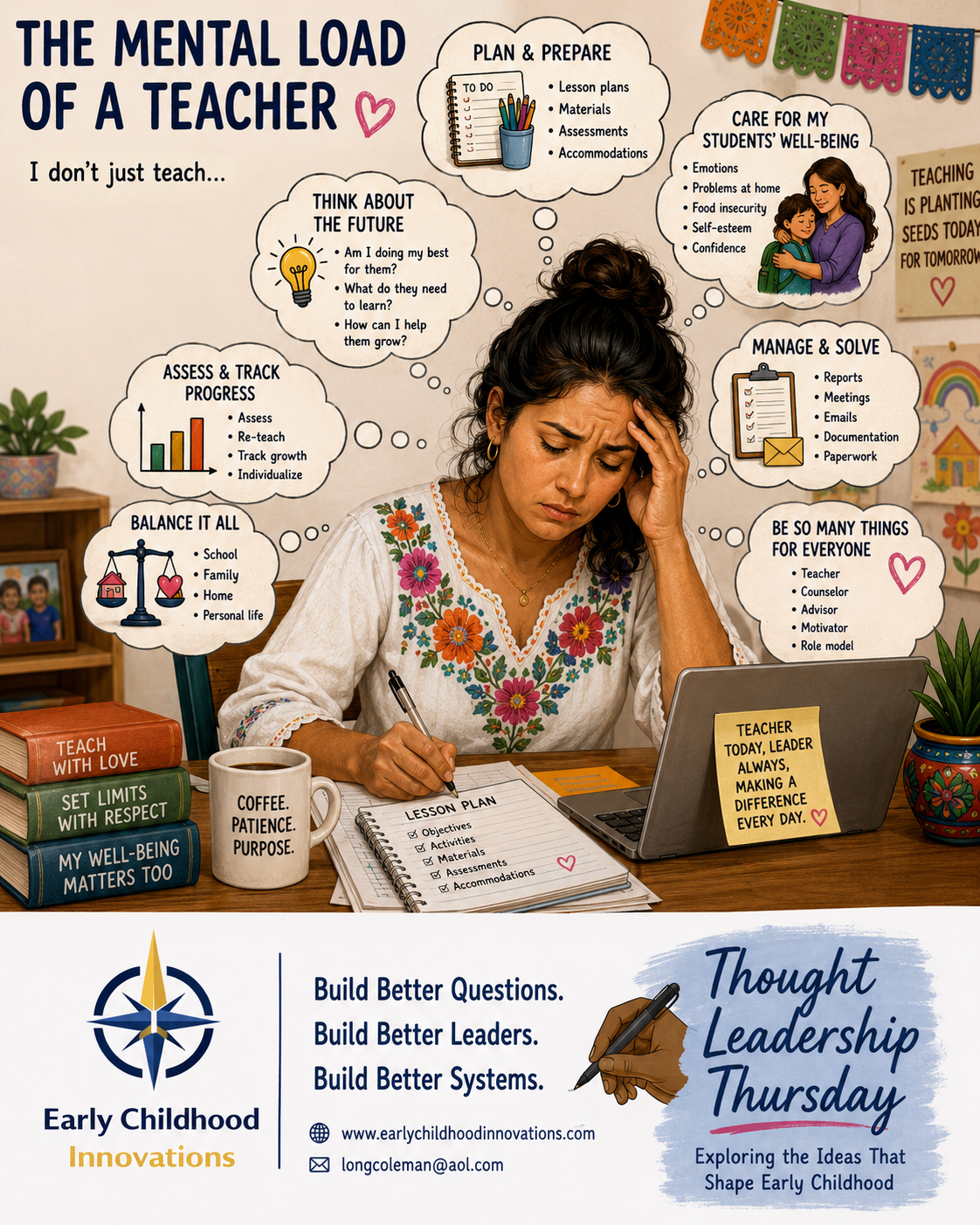
There is work we can see in early childhood education: teaching, preparing activities, communicating with families, supervising children, completing paperwork, cleaning, and managing routines.
Then there is the work happening inside an educator’s head.
Remembering. Anticipating. Monitoring. Prioritizing. Adjusting. Problem-solving. Making one decision while already thinking about the next three.
This is part of mental load is the invisible thinking work required to plan, remember, anticipate, organize, monitor, and continually make decisions across multiple roles.
For child care educators in particular, those roles can accumulate quickly. An educator may simultaneously function as teacher, business owner, safety officer, behavioral specialist, family communicator, household manager, and administrator.
The work may look effortless from the outside.
The thinking required to make it look effortless is often invisible.
When the Brain Is Carrying Too Much
Mental load is not simply about having a long to-do list.
Consider two responsibilities. One may take an hour but require relatively little thought. Another may take only ten minutes but require you to anticipate problems, remember several pieces of information, make decisions, regulate your emotions, and consider how your decision will affect children, families, employees, or your business.
Which one is more mentally demanding?
Research on cognitive load helps explain why this distinction matters. Our brains have limited capacity for processing information at one time. Working memory helps us remember, organize, prioritize, and make decisions, while executive function allows us to plan, focus attention, remember instructions, control impulses, and adapt when circumstances change.
Early childhood professionals may be using all of these abilities simultaneously.
Add interruptions, task switching, emotional demands, safety responsibilities, documentation, family communication, and continuous decision-making, and mental fatigue becomes understandable.
The question, then, isn’t simply:
How much are you doing?
It may be:
How much are you carrying in your head while you’re doing it?
Awareness Is Important But It Isn’t Enough
Professional development often begins by introducing new information. We explain a concept, discuss the research, provide strategies, and hope participants will use what they have learned.
But knowing something and changing something are not the same.
Meaningful professional learning should help us move through four stages:
Awareness: What is happening?
Evaluation: Where is this showing up in my work?
Self-discovery: What am I beginning to recognize about myself?
Application: What will I do differently because of what I discovered?
That progression matters.
An educator can understand the definition of mental load without recognizing which responsibilities are creating the greatest burden. An educator can recognize those responsibilities without examining why they continue carrying them. And they can understand all of that without making a change.
Reflection creates the bridge between information and action.
Try This: A 60-Second Mental Load Check
Take a moment and consider these three questions:
1. What is taking the most mental energy, not necessarily the most time, in my work right now?
Don’t immediately think about your biggest task. Think about what continues occupying your mind.
2. What am I repeatedly remembering, deciding, anticipating, or monitoring?
Look for responsibilities that require you to keep information constantly available in your head.
3. What is one thing I could simplify, systematize, share, or stop?
You don’t have to solve everything. Identify one place where a small change could create some mental space.
That is where reflection begins becoming application.
From “Do More” to “Think Differently”
When professionals feel overwhelmed, our response is sometimes to give them another strategy, another resource, another training—or another thing to do.
But adding more isn’t always the answer.
Sometimes we need to examine the work already being carried.
Can a recurring decision become a routine?
Can information you’re trying to remember be captured in a system?
Can similar tasks be grouped to reduce unnecessary switching?
Can a responsibility be shared?
Can a boundary be established?
Can something simply wait until tomorrow?
These questions shift the conversation from “How can I manage more?” to “How can I work more intentionally?”
That distinction is important for sustainable leadership and professional practice.
Making the Invisible Visible
In my work with early childhood professionals, I use a more extensive Mental Load Reflection & Action process to help educators examine invisible responsibilities, identify what contributes most to their mental burden, recognize patterns, and translate those discoveries into realistic commitments for change.
The purpose isn’t to eliminate responsibility.
It is to become more intentional about how we carry it.
Because sometimes the first step toward changing our work isn’t another solution.
It’s a better question.
So I’ll leave you with this one:
What are you carrying mentally that no one else can see, and what might change if you finally made it visible?
About the Author
Victoria Long-Coleman, Ph.D., MBA is the Founder and Principal of Early Childhood Innovations. An early childhood educator, leadership coach, author, and speaker, she focuses on strengthening educators, developing leaders, and translating research into practical approaches that improve early childhood systems.
Early Childhood Innovations
Building Better Questions. Building Better Leaders. Building Better Systems.
www.earlychildhoodinnovations.com
