We Keep Promoting Great Teachers, and Then Wonder Why They Struggle as Directors
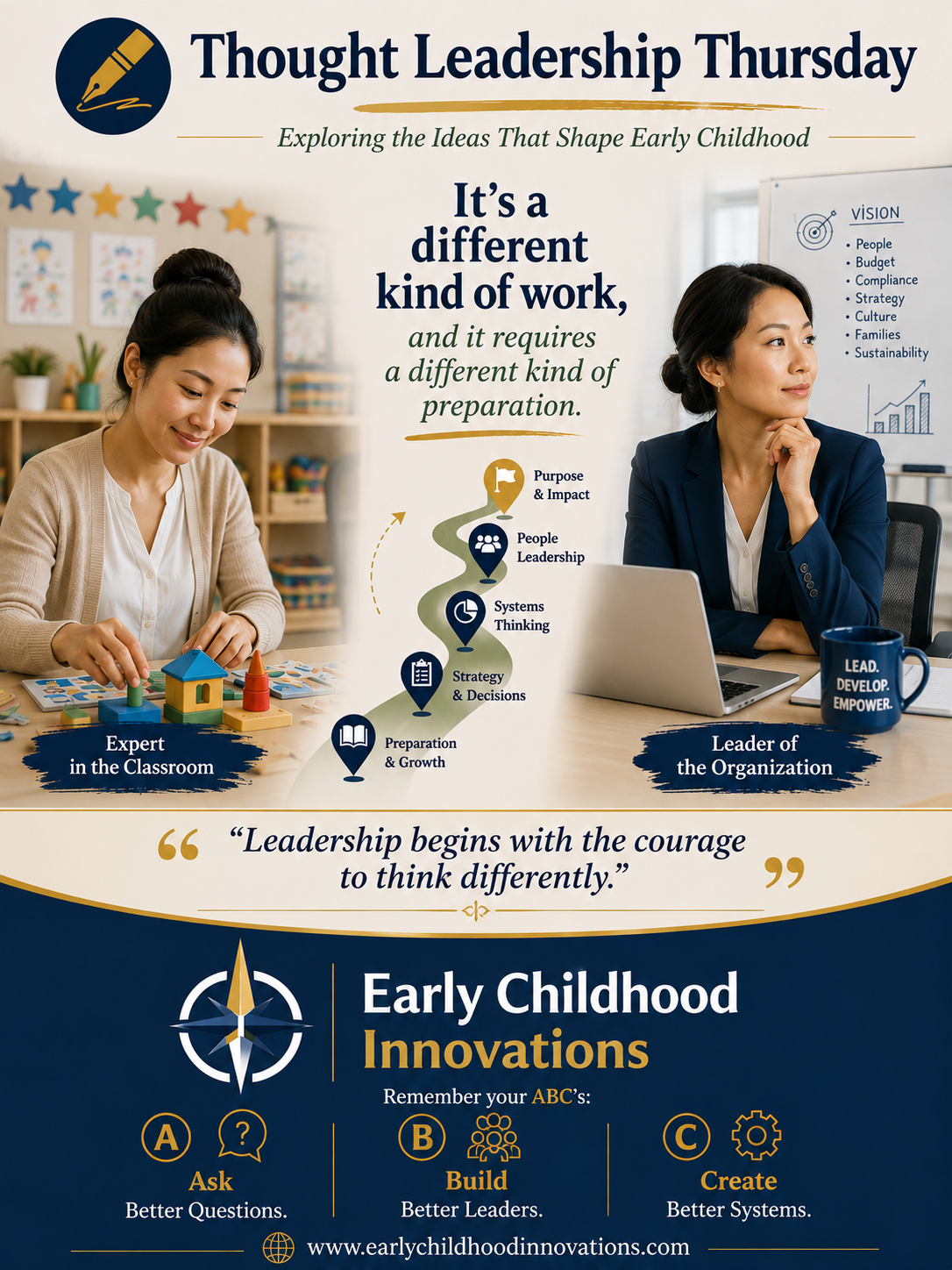
There is a familiar pattern in early childhood education. A teacher is exceptional with children. Her classroom is organized, families trust her, she understands child development, and other teachers frequently seek her advice. When something needs to be done, she is often the person who steps forward. So, when a leadership position becomes available, promoting her seems like the obvious next step.
She becomes a lead teacher, perhaps an assistant director, and eventually a director. Then we are sometimes surprised when the transition does not go as smoothly as expected. Staffing problems overwhelm her, difficult conversations feel very different when she is responsible for initiating them, and delegation can be challenging when doing the task herself seems faster. Before long, someone is wondering, “She was such a great teacher. Why is she struggling as a director?”
I think that question deserves another question: What did we do to prepare her?
Being Good at the Work Is Not the Same as Being Prepared to Lead It
My thinking about this comes from seeing leadership from several sides. Over the course of my career, I have been a family child care educator, classroom teacher, Georgia Pre-K teacher, center director, technical-assistance specialist, coach, trainer, and organizational leader. Before much of my early childhood career, I also worked in corporate insurance in supervision, customer service, and sales. Those experiences exposed me to very different expectations about people, performance, responsibility, and leadership.
When I became a center director, I already understood children, classrooms, curriculum, teachers, and families. What changed was the level at which I had to think. A classroom problem could also be a staffing problem. A staffing decision could affect morale, and a financial decision could affect staffing, quality, families, and ultimately children’s experiences. Even a conversation I postponed could become a larger organizational problem later.
The view changes when you become responsible for the whole system.
Looking back, I can also see that some of the experiences that helped me navigate leadership happened long before I held certain leadership titles. I had supervised people, worked in different organizational environments, interacted with customers and families, and been responsible for decisions and their consequences. I did not necessarily think of all those experiences as “leadership development” when they were happening, but they became part of what I drew upon later.
Not every emerging early childhood leader gets that opportunity. Some move almost entirely from classroom experience into administration, with relatively little exposure to the very different demands of leading adults and organizations. When that happens, struggle should not automatically be interpreted as evidence that we chose the wrong person.
Promotion and Preparation Are Not the Same Thing
Early childhood has an informal career philosophy that often looks something like this: do your current job well, and eventually we will give you a bigger one. There is nothing wrong with promoting talented educators. We should want strong professionals to see opportunities for growth in our field. The problem comes when we assume that excellent performance in one role automatically predicts readiness for another role that requires substantially different skills.
Teaching young children requires tremendous expertise. Directing an early childhood program requires expertise as well, but the responsibilities are not interchangeable. A teacher’s attention is largely centered on children, families, curriculum, the learning environment, and the functioning of a classroom. A director must understand those things while simultaneously paying attention to people, resources, regulations, organizational culture, communication, competing priorities, and the consequences of decisions across the entire program.
That is a significant professional shift, yet preparation for it can sometimes be remarkably informal. An educator watches the current director, takes on a few administrative duties, fills in when someone is absent, and eventually hears, “You’re ready.” The organization may genuinely believe it is rewarding and developing a strong employee, but it may actually be placing that employee into a fundamentally different job without enough opportunity to understand what that job requires.
Perhaps, then, struggle is not always evidence that we selected the wrong person. Sometimes it may be evidence that we never developed a process for preparing the right person.
Leadership Development Should Begin Before the Vacancy
Over the years, I have watched capable educators move into leadership carrying deep knowledge of children, curriculum, and families but with far fewer opportunities to practice leading adults, navigating organizational decisions, or thinking beyond one classroom. That observation has increasingly shaped the questions I ask about leadership development.
What if we stopped waiting until someone becomes a director to teach her how to lead?
That does not mean every teacher should be placed on a path toward administration. In fact, I believe early childhood needs to challenge the idea that professional advancement must eventually mean moving farther away from children. An exceptional teacher may want greater compensation, professional recognition, influence, and responsibility while remaining close to teaching. We should be able to recognize expertise without making management the primary reward for excellence.
For educators who do aspire to administration, however, preparation should begin well before a director announces that she is leaving. Organizations can start by paying attention to leadership potential, having conversations about professional aspirations, and creating opportunities for people to stretch beyond the responsibilities they already know how to perform. The exact approach will differ from one organization to another, but the principle is the same: people should have opportunities to grow into leadership rather than simply being placed into it.
This also changes the way we think about succession. Instead of waiting for an opening and asking, “Who can we put in this position?” organizations can continually ask whether they are developing people who could assume greater responsibility in the future. That is a very different organizational habit.
A Different Question for Early Childhood
After years of working with teachers, directors, coaches, programs, associations, and leadership groups, I have become less interested in asking, “Who is ready for the next position?” I am increasingly interested in asking, “What are we doing now to help people become ready for what comes next?”
That change in language matters because it shifts some of the responsibility from the individual to the organization. Leadership readiness is certainly personal. Individuals must be willing to learn, stretch, receive feedback, make decisions, and accept greater responsibility. Leadership development, however, is also organizational. When a newly promoted director struggles, we can examine what that person still needs to learn while also examining the system that promoted her.
Did we recognize her potential early enough? Did we help her understand how leadership would differ from teaching? Did she have meaningful opportunities to grow before the stakes became so high? Was someone intentionally developing her, or were we simply hoping that experience would eventually take care of it?
These questions matter beyond the success of one director. They affect staff stability, organizational culture, program quality, succession, and ultimately the experiences of children and families. Early childhood has invested considerable attention in preparing educators to understand and teach children, and that work remains essential. Strong programs, however, also depend on people who are prepared to lead the adults, organizations, and systems surrounding those children.
A great teacher may absolutely become a great director. We just shouldn’t expect the promotion itself to prepare her.
The question I hope more early childhood organizations will begin asking is this: Who are we developing today for responsibilities they haven’t been given yet?
About the Author
Victoria Long-Coleman, Ph.D., MBA is the Founder and Principal of Early Childhood Innovations. An early childhood educator, leadership coach, author, and speaker, she focuses on strengthening educators, developing leaders, and translating research into practical approaches that improve early childhood systems.
Early Childhood Innovations
Remember your ABC’s:
ASK Better Questions. BUILD Better Leaders. CREATE Better Systems.
www.earlychildhoodinnovations.com
