When the Thorn Isn’t the Problem: What Happens When Early Childhood Leaders Think Together
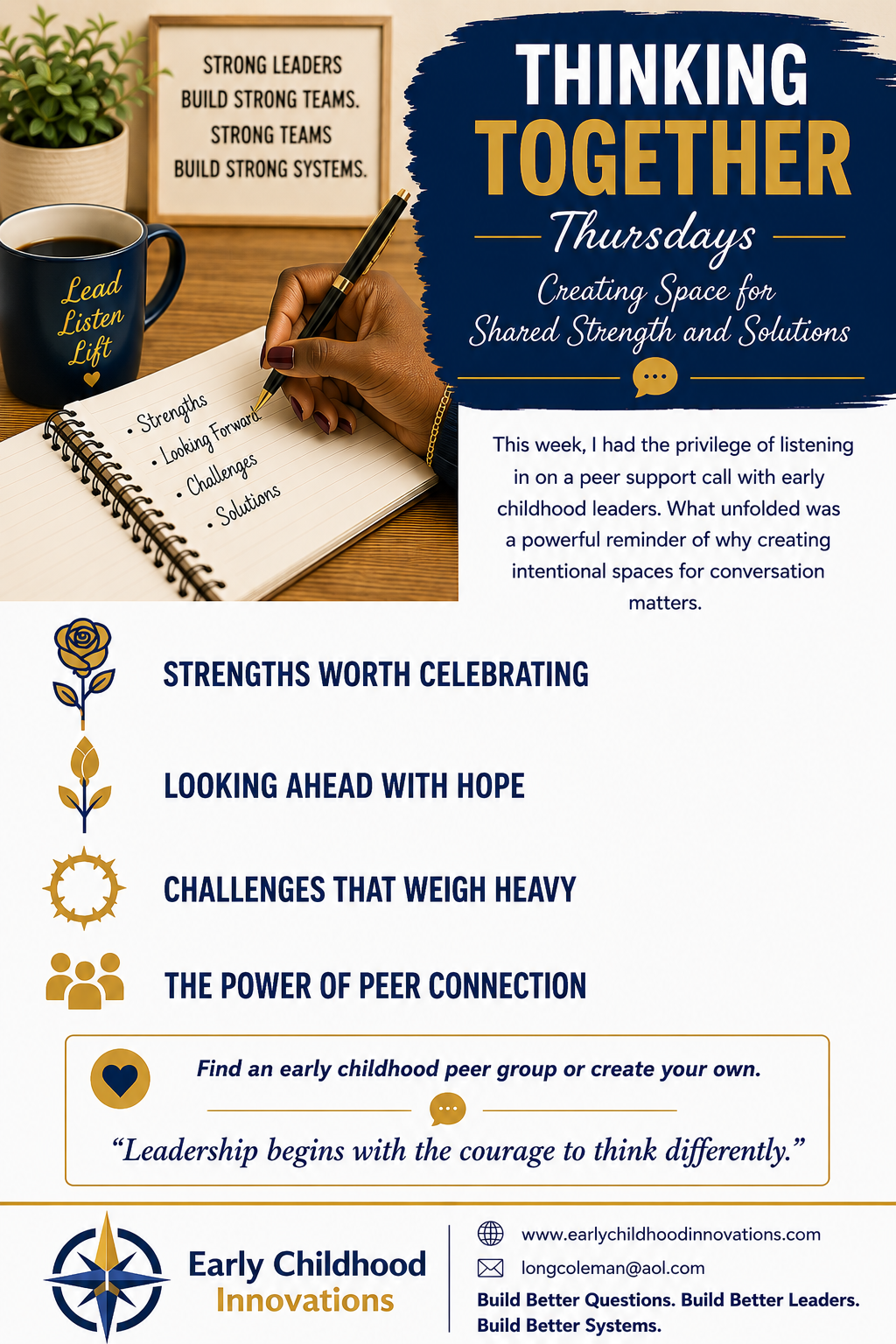
Recently, I had the opportunity to listen to a group of early childhood leaders talk openly about what was going well or a “rose,” what they were looking forward to or a “bud,” and what was challenging them or a “thorn.” I was there primarily to listen, and that is exactly what I did.
As the conversation unfolded, I found myself paying less attention to individual problems and more attention to the patterns connecting them. Staffing challenges. Enrollment concerns. Financial pressures. Changing expectations. Leaders filling multiple roles because positions could not be filled or funded. Directors trying to support employees who needed help making everyday decisions while simultaneously managing the larger responsibilities of their programs.
None of these challenges surprised me. After decades in early childhood education, I have heard many versions of them before. What caught my attention was hearing them surface together. When similar concerns continue to appear across programs and among leaders with different experiences, perhaps we should stop viewing them only as individual operational problems. They may also be telling us something about the systems in which early childhood leaders are expected to work.
When the Same Problems Keep Returning
Early childhood leaders are remarkably resourceful. Someone calls out, and we figure out classroom coverage. Enrollment drops, and we increase marketing efforts. A teacher struggles, and someone steps in to coach. A family has a concern, and the director responds. A position remains vacant, and another person absorbs the responsibilities.
The immediate problem gets solved, but solving today’s problem does not necessarily prevent tomorrow’s version of it.
That distinction matters. If one director is overwhelmed, we might ask what support that director needs. If leaders across multiple programs are overwhelmed by similar responsibilities, we should ask a different question: What conditions are creating this pattern?
This is where I believe early childhood organizations have an opportunity to move from problem-solving to organizational learning. We certainly need to help leaders address immediate challenges, but we also need to become better at recognizing when repeated challenges are evidence of something larger.
The Workload We See and the Thinking Load We Don’t
One pattern that deserves more attention is the amount of organizational thinking leaders carry.
We often talk about workload: schedules, budgets, staffing, enrollment, family communication, compliance, training and supervision. Those responsibilities are visible and relatively easy to identify. What is less visible is the constant thinking underneath them.
A director may be considering whether a classroom needs additional support while remembering that a teacher is struggling, an enrollment inquiry needs follow-up, a family needs a phone call, a regulation has changed, payroll is approaching, and tomorrow’s staffing schedule has a hole in it. Yet, that leader may be coaching employees, resolving conflicts, answering questions and anticipating problems that have not happened yet.
That is not simply workload. It is leadership mental load.
Organizations routinely monitor enrollment, staffing ratios, vacancies, revenue and compliance. We are less likely to examine how much decision-making, problem-solving and organizational knowledge has become concentrated in one person. Yet that concentration may be one of the greatest vulnerabilities in an early childhood program.
Strong leadership should not mean that one person becomes the system.
In fact, one of the most important forms of leadership development may occur when the director does not immediately provide the answer. When educators are encouraged to assess situations, use established processes, exercise professional judgment, communicate appropriately and recognize when an issue truly requires escalation, they develop their own leadership capacity. Over time, problem-solving becomes distributed rather than concentrated at the top.
That is more than delegation. It is how we build stronger organizations and future leaders.
What Happens When Leaders Have a Place to Think Together?
The conversation I observed also reminded me of something we sometimes underestimate in professional learning. The knowledge already sitting in the room.
People did not pretend to have everything figured out. They talked about challenges, offered suggestions, compared experiences and encouraged one another. Sometimes someone had a strategy. Sometimes someone had experienced a similar problem. Sometimes what another leader needed most was simply to know that others understood.
There is tremendous value in that kind of trusted professional space.
Traditional professional development often begins with an expert who brings knowledge to participants. Peer learning begins from a different premise. Experienced practitioners already possess valuable knowledge, and bringing their experiences together can produce new understanding. A problem that feels isolated inside one program can look very different when several leaders realize they are experiencing variations of the same thing.
That is when peer support can become collective intelligence.
The challenge is protecting the trust that makes honest conversation possible while also learning from the patterns those conversations reveal. Confidential spaces should never become opportunities to collect or expose people’s personal struggles. But organizations can still ask broader questions. What challenges continue to surface? What professional learning needs are emerging? Where are leaders developing promising solutions? Which issues can programs address themselves, and which require organizational or policy change?
The people closest to the work may recognize emerging system problems long before those problems appear in formal reports.
The Thorn May Be Evidence
We need places in early childhood where leaders can say, “This is hard,” without immediately being expected to have a solution. But support should not prevent us from becoming curious about what we are hearing.
When the same challenge appears again and again, we should ask why.
What are we learning? What can we solve together? What requires a different organizational structure? Where do educators need greater decision-making authority? Where are leaders carrying responsibilities that should be distributed? What are practitioners already doing that others could learn from?
These are different questions from, “How do we fix today’s problem?”
They move us from reaction toward learning.
There will always be successes to celebrate, possibilities to anticipate and challenges to address in early childhood. That is the nature of work involving people, organizations and changing communities. But when the same thorn keeps appearing in different places, we should resist the temptation to simply become better at pulling it out.
The recurring thorn may be the evidence we need to redesign the system that keeps producing it.
About the Author
Victoria Long-Coleman, Ph.D., MBA is the Founder and Principal of Early Childhood Innovations. An early childhood educator, leadership coach, author, and speaker, she focuses on strengthening educators, developing leaders, and translating research into practical approaches that improve early childhood systems.
Early Childhood Innovations
Building Better Questions. Building Better Leaders. Building Better Systems.
www.earlychildhoodinnovations.com
